U.S. Civil War
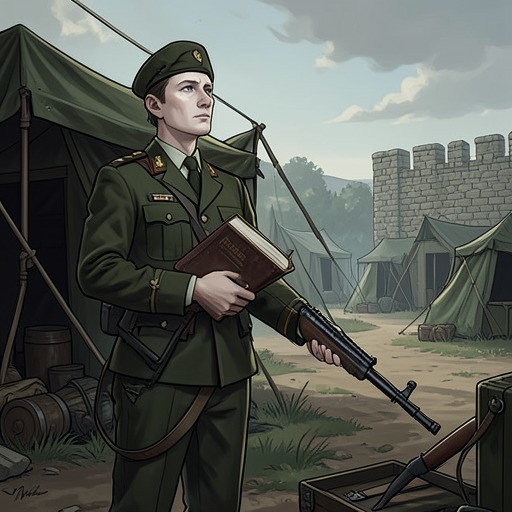
The Surgeon of CrowthorneThe U.S. Civil War enters William Chester Minor’s story as both a national catastrophe and a possible turning point in one man’s life. Trained as a physician at Yale University, Minor joined the Union Army when it urgently needed medical staff. His service brought him from relatively sheltered hospital work into the realities of the Virginia campaign, where the scale of suffering and the limits of contemporary medicine form an important backdrop to the illness that later shaped his life. The account suggests that the war may have helped bring that illness to the surface, but does not claim to prove a direct cause.
A surgeon enters a national crisis
Minor graduated from Yale Medical School in February 1863, aged twenty-nine, with a degree and a specialization in comparative anatomy. His earlier medical training had included a serious infection after he cut his hand during a post-mortem; his doctors later said that he had been gravely ill and nearly died. In 1863, as the war continued to demand medical personnel, he applied to serve as an army surgeon. The Union Army trained him at Knight Hospital in New Haven, close to home, and accepted him as an apparently competent physician.
When Minor signed his first army contract, about eight hundred days of fighting had already passed. The account places his enlistment amid a conflict marked by reversals and a long succession of battles, including the First and Second Battles of Bull Run, Fredericksburg, Antietam, Chancellorsville and Vicksburg. It also names lesser-remembered contests at Big Black River Bridge, Island Number Ten and Greasy Creek. The Union Army had suffered years of bitter fighting, while the South had won many victories; the army was eager to recruit men it considered capable.
The Battle of Gettysburg followed soon after Minor joined. Accounts of the battle filled the newspapers he read in New Haven. Union casualties numbered 22,000, and Connecticut lost more than a quarter of the men it sent to Pennsylvania during the first three days of July, when the fighting was worst. The battle became a turning point after which the Confederacy’s military ambitions began to fail. For Minor, the news also offered the prospect of active medical service. His brother later testified that he was eager to be sent to the seat of battle.
From hospital wards to the Virginia campaign
Minor’s first work was in New Haven, treating men brought away from fighting to recover. By August he had been fully sworn into service, and by November he had a formal contract as an acting assistant surgeon, available for whatever the Surgeon-General’s Department required. It took another six months for the army to send him south. His orders called for him to travel from New Haven to Washington and then to a medical office in Alexandria, where he was to replace a doctor named Abbott. Before proceeding to that post, he went into the field, possibly at the Medical Director’s direction. The account describes this as the only time in his career when he saw actual fighting.
The campaign that brought him there was part of a change in Union strategy. After the Gettysburg victory, President Lincoln placed Union forces under General Ulysses S. Grant, who planned to destroy the Confederate Army rather than conduct a succession of disconnected campaigns. In this strategy, the enemy army’s continued ability to fight sustained the Confederacy; defeating it was therefore central to defeating the secessionist cause.
In May 1864, Grant’s forces began moving south from the Potomac. On 4 May they crossed the Rapidan River into Orange County, Virginia, and met the Army of Northern Virginia. The resulting Battle of the Wilderness, which began with the river crossing and ended after Grant’s men moved toward Spotsylvania, lasted about fifty hours and cost roughly 27,000 lives. The account presents the battle as one of the most fiercely contested early tests of Grant’s campaign, when the Confederate army was still determined and relatively unbroken.
The cost of battle and medical care
The war’s weapons could inflict devastating wounds, but the medical care available to soldiers remained primitive. The account emphasizes this imbalance: men faced mortars, muskets and Minié balls at a time when modern medicines such as penicillin and sulphonamides were not available. In field hospitals, gangrene, infection, disease and poor hygiene compounded the immediate consequences of wounds. Doctors could regard pus in a wound as a sign of healing, a measure of how different medical understanding was from later practice.
The casualty figures convey the scale of loss beyond any single engagement. About 360,000 Union troops and 258,000 Confederates died during the war. For every soldier who died from wounds caused by new weapons, two died from infection, illness or poor hygiene. The account’s focus on these conditions makes Minor’s role as a surgeon part of the war’s human cost: his work confronted suffering in a medical system with limited means to prevent it or relieve it.
War, illness and the limits of explanation
Minor’s time in Virginia is presented as a possible context for the later deterioration of his mental health, not as a conclusively established explanation. The account describes him before the war as sensitive, courteous, academic and gentle, with interests in reading, painting and playing the flute. It proposes that the sights and conditions of the campaign may have affected a mind already vulnerable to illness, but also acknowledges that the cause of such an illness cannot be pinpointed with confidence.
The chronology offers reasons to consider the question without resolving it. In the summer of 1868, after reporting severe headaches and vertigo, Minor was sent to New York for examination. On 3 September, Surgeon Hammond described him as suffering from monomania and classified him as delusional. By November, army doctors considered his condition serious enough to recommend institutional care; an examining physician said the monomania had become suicidal and homicidal. Decades later, at St Elizabeths Hospital, a psychiatrist diagnosed him with dementia praecox of the paranoid form, a historical diagnostic term associated with the development of what came to be called schizophrenia.
The book returns to the Civil War when considering possible triggers for Minor’s illness, including the Battle of the Wilderness, but leaves the question open. It also considers other possibilities, among them inherited susceptibility and the effects of his temperament, and cautions against treating a later diagnostic label as a complete explanation of an individual life. The war’s place in Minor’s story is therefore significant but uncertain: it supplies a plausible setting for a crisis, while the evidence presented cannot establish that the battlefield caused his illness.